
SpaceX Goes Public, the Hot Jobs Report, and the AI Narrative Flip
SpaceX is about to pull off the largest stock market debut ever, and its pitch reveals where the smart money thinks the next decade of profit lies. (SPCX).
Disclaimer: Frontier Lane provides this content for informational and educational purposes only, not as investment advice. Please read our full Disclaimer for more information.
Welcome to our first edition of Frontier Briefings, where we'll share our thoughts on news we find interesting on a regular basis. We like to think of this as a short, sharp, interesting weekend read for you as you think about the week ahead. We welcome any thoughts and feedback as always: research@frontierlane.com.
Let's talk SpaceX
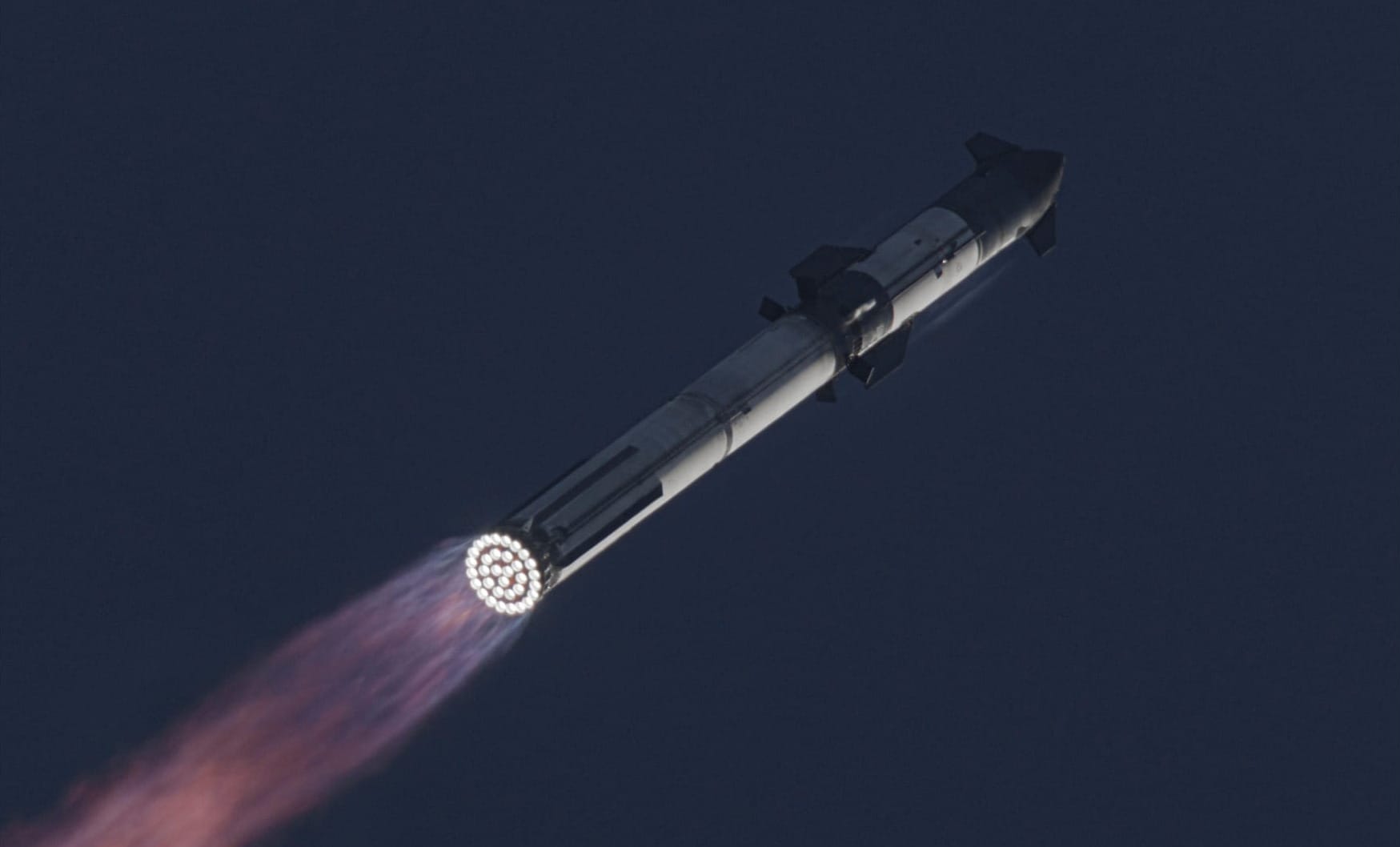
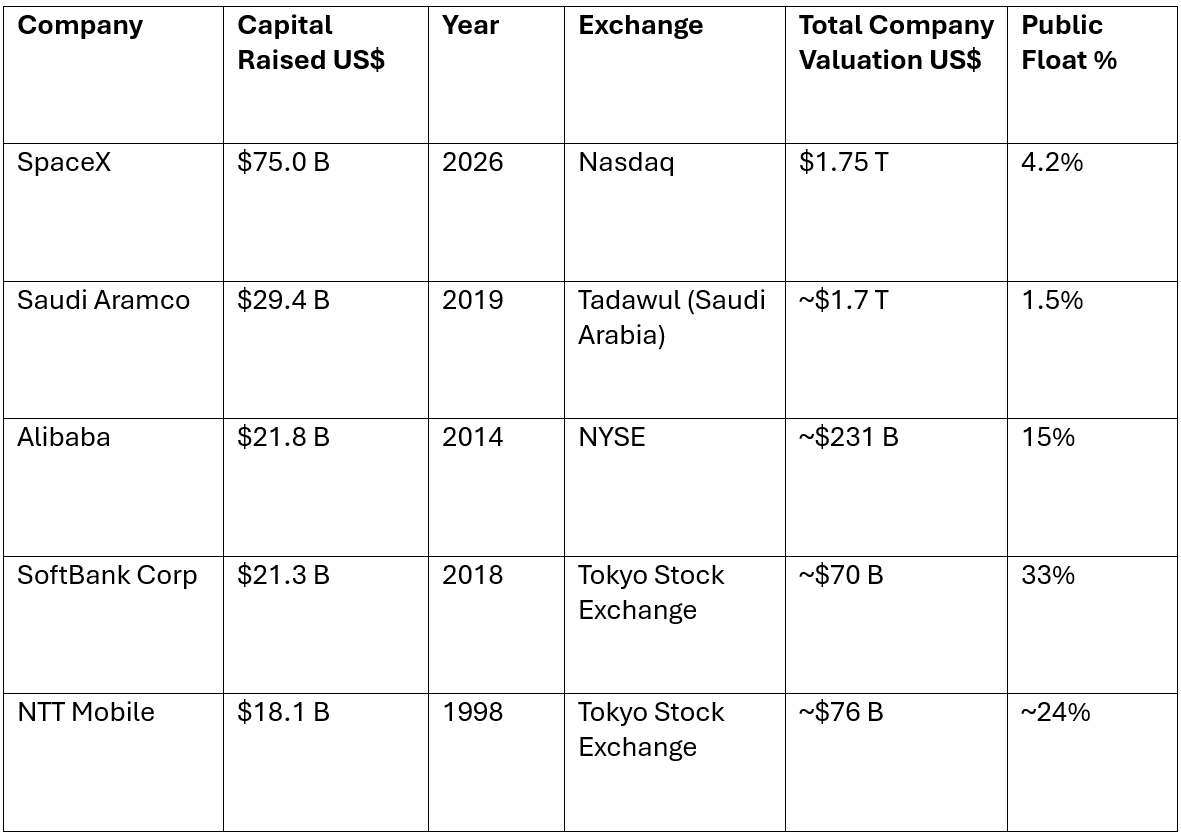
As we all have been reading the headlines, on 20 May SpaceX filed its initial S-1 IPO document to the SEC. The company is looking to raise $75 billion at $135 a share, valuing the firm near $1.75 trillion. That would make it the largest stock market debut ever by a wide margin (the previous IPO record was set by Saudi Aramco raising $29 billion in 2019). The company is aiming to trade on the NASDAQ on 12 June 2026, and the ticker will be SPCX. None of the existing shareholders will be selling down, so the public float being offered represents around 4.2% of the total shares of the SpaceX. According to latest sources, the order book is running two times oversubscribed.
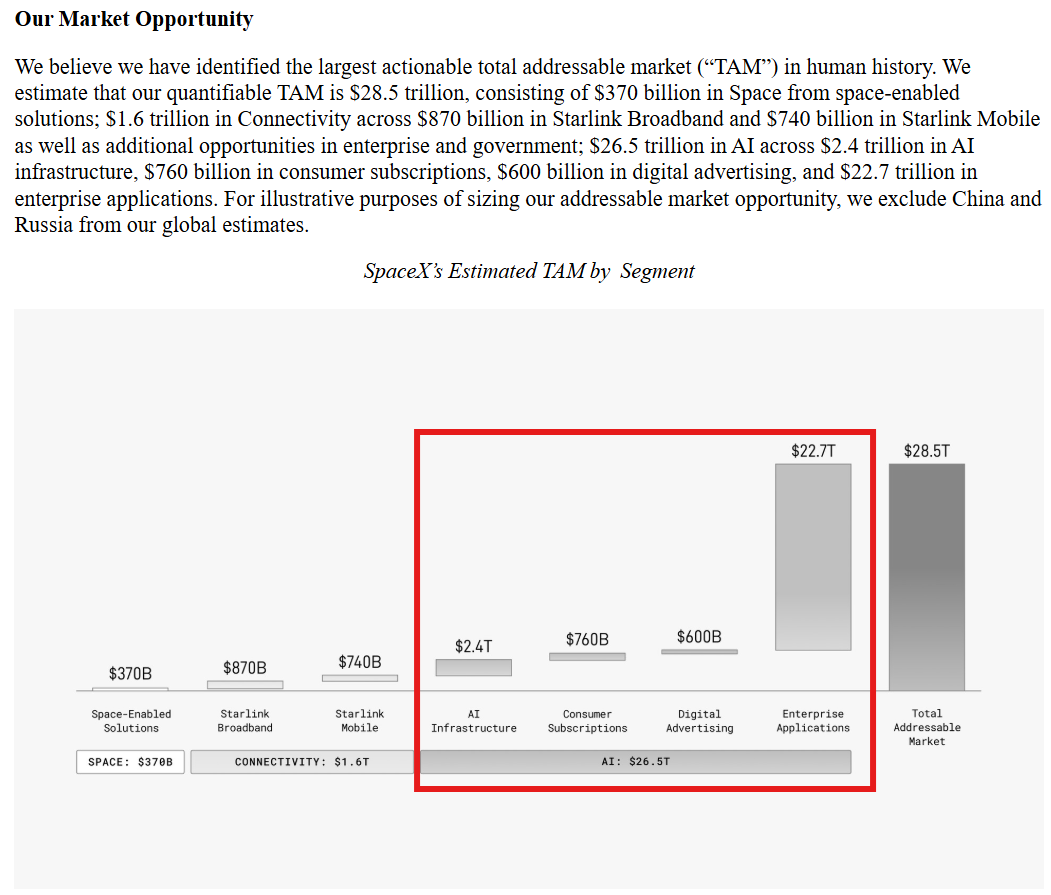
The pitch is staggering in scope: the company claims a "total addressable market" of $28.5 trillion, most of it ($26.5 trillion) in artificial intelligence. The interesting angle most people are missing is how the numbers actually break down today. Connectivity (Starlink) is the real engine, throwing off $7.2 billion in segment profit last year. Space loses money. The newly bought AI arm (xAI, Grok, the old Twitter) lost $6.4 billion. So investors are paying a trillion-plus partly for businesses that bleed cash now, on the promise of space-based data centres by 2028.
One detail in the filing deserves more attention than it is getting. SpaceX has signed deals to rent out spare AI computing power. Google will reportedly pay about $920 million a month (peanuts for Google given their $46 billion operating cash flow generated in the March 2026 quarter), and Anthropic has agreed to pay $1.25 billion a month. That is real, recurring money from rivals who need compute now. It turns SpaceX's expensive data centres from a cost into an income stream while the firm waits for its own models to mature. The neat trick: SpaceX can reclaim that capacity for itself whenever it wants. This is the kind of practical cash generation that could quietly support the valuation while the grander space dreams play out. It also makes SpaceX a sudden competitor to cloud-rental firms like CoreWeave.
Musk is reportedly refusing to move the $135 price even as demand runs at twice the shares on offer. That tells you he holds the cards. For the record, Elon holds 93.6% voting power in the company pre-IPO, and after IPO will hold 84.4%.
The inflection point to watch: whether Starship actually starts delivering payloads in the second half of 2026. Almost every growth claim, from cheaper satellites to orbital AI, hangs on that one rocket working at scale. If it slips, the story gets harder. We would also flag the dual-class structure: Musk keeps voting control through Class B shares with ten votes each. You are buying the vision, not a say in it. Stay tuned, we'll write a specific piece on SpaceX before their listing date.
A hot jobs report kills the rate-cut hope
The US economy added over 172,000 jobs in May, well above forecasts. Normally good news, but it pushes Federal Reserve rate cuts further away, and stocks fell on it. The second-order point that ties to our other themes: there is a real tension between a strong economy and the deficit. As one report noted, the ballooning government deficit is keeping mortgage rates near 6.5% regardless of what the Fed does. High borrowing costs make it dearer for everyone, including the AI giants now seeking to raise capital, to fund expansion. Expensive money is the common enemy of every growth story this week. Watch for the CPI inflation print coming out on Wednesday morning US East Coast time.
Chips just lost $1.3 trillion, and the timing is no accident
While SpaceX sells the AI dream, the chip sector had its worst week in memory (no pun intended). Roughly $1.3 trillion in value evaporated, with the Nasdaq down over 4% on Friday. The thread that connects this to everything else: the market is starting to ask whether all this AI spending will ever pay off. One reason given is "model routing", software that sends simple questions to cheap AI models instead of expensive ones. If that catches on, it dents demand for the priciest chips and squeezes the firms selling premium AI by the token. That is a direct challenge to the SpaceX thesis that compute demand only ever goes up.
OpenAI and the strange new world of government stakes
The Trump administration is reportedly discussing taking a stake in OpenAI, and Trump is set to meet AI leaders about US investment in their firms. This is a notable shift. Government is treating AI like critical national infrastructure, the way it once treated railways or defence. For investors, that cuts both ways. State backing could prop up valuations and guarantee demand. But it also brings political strings, scrutiny, and the risk that commercial logic takes a back seat. SpaceX, with roughly a fifth of its revenue from the US government already, is well placed here. Firms seen as strategic national assets may get a quiet floor under them.
The retail crowd piles back in
Finally, the SpaceX float has reignited everyday investor enthusiasm, with ordinary buyers across Europe and beyond clamouring for a slice. The company is targeting SpaceX is even reserving shares for retail through platforms like Robinhood and Schwab. History tells us retail euphoria near a record-breaking IPO, in the same week a major sector loses $1.3 trillion, is a moment for care rather than fear of missing out. The excitement is genuine and the company is remarkable. But great company and great investment are not always the same thing, especially at a trillion-plus valuation built on milestones still to come. On this point, it’s no surprise that the bitcoin price has dropped to the $60,000 range off the back of many upcoming “hot investment opportunities” such as SpaceX, Anthropic and potentially OpenAI.
What to watch next: whether SpaceX holds its $135 price into pricing day, whether Starship flies on schedule in the second half of the year, and whether the chip sell-off steadies or spreads. The mood is turning from "spend at any cost" to "show me the cash." We think that shift matters more than any single deal, and we are positioning accordingly.
Oil, Iran, and a choke point to watch
US forces struck Iranian radar sites after Iran launched drones towards the Strait of Hormuz. Global oil stocks are already depleted, and analysts warn the next price spike could roil markets. The connection to our themes is energy. AI runs on electricity, and SpaceX's whole orbital-compute pitch rests on the idea that earthbound power is too scarce and costly. A genuine oil shock would make that argument louder, but it would also hammer the wider market and raise costs everywhere. Energy security is quietly becoming an AI story.
Things to watch this week
- Wednesday’s US CPI Print: Following the hot jobs report, a stubborn inflation reading will cement "higher for longer" interest rates, a direct headwind for capital-intensive tech.
- Thursday's SpaceX Pricing: The undisputed main event. With the order book reportedly hitting $150 billion (2x oversubscribed), Musk’s $135 fixed price is expected to hold ahead of Friday’s Nasdaq debut.
- The Liquidity Vacuum: As this mega-cap debut pulls in capital, we are watching closely to see if the broader chip and AI sectors can stabilize, or if market liquidity gets sucked straight into orbit.
Enjoyed this research?
Receive our future Research and Frontier Briefings.
Frontier Lane also works with a select group of long-term investors, founders and family offices on capital allocation and investment strategy.